AI Portfolio
AI Product Development Team
A planner, an orchestrator and specialist agents, with me as the only human in the loop
The Problem
I know the whole lifecycle. The missing piece was capacity.
The full walkthrough: how the team plans, builds and market-tests a real tool, with me as the only human in the loop.
I've spent twenty years inside the product lifecycle. I've concepted close to fifty mobile apps, and been part of building seventeen more across web, embedded systems, omni-channel services and core system renewals. Product management and every design role along the way, those are home for me. The technical side I understand too, I have a master's degree in it, even if I'm not the one writing production code all day.
So the whole arc from rough idea to shipped product is familiar. The problem was never knowing what good looks like. It was capacity. As a solo operator I can hold the strategy, the concept, the design and the judgment, but I can't personally build, test and ship all of it at once. Ideas stall in that gap, and mine stalled there for years.
That's the part that makes the AI era genuinely exciting to me. Not the hype, the actual question: how far can one person who knows this lifecycle inside out get with a team of agents doing the execution? This is me finding out.
The Team
Roles, not one big prompt
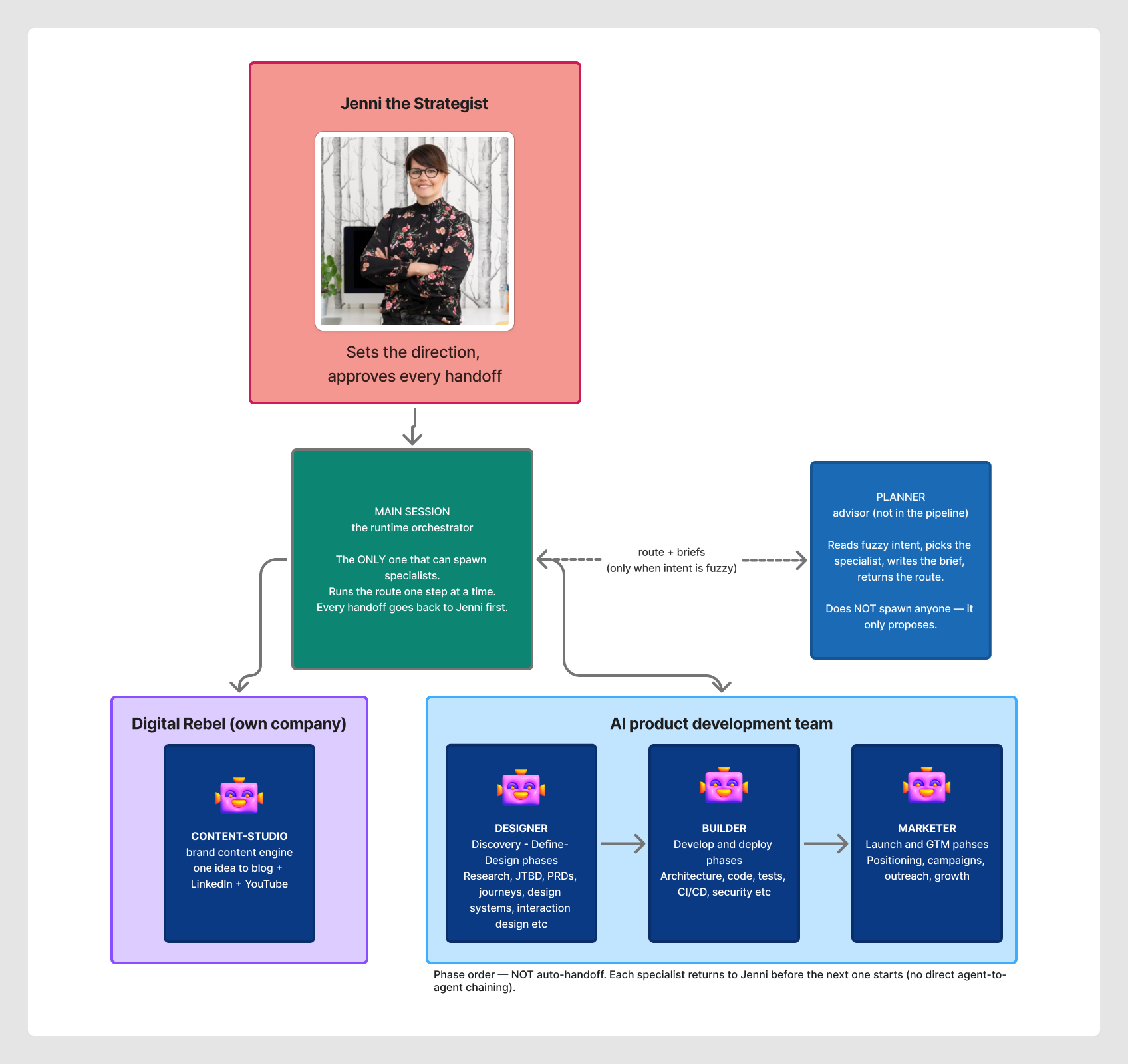
I built it the way I'd structure a real product team. Each agent owns one slice of the lifecycle and nothing else.
The front of the system is two things, not one. A planner is the advisor: I describe what I want in plain language and it reads the intent, picks the right specialist, sequences the steps and writes the brief for each one. But it only proposes a route, it never spawns anyone. The actual orchestrator is the main session, the one thing that can call a specialist, and it runs the route one step at a time.
Underneath sit the specialists. The designer owns discovery, definition and design, where research turns into a concept and a PRD. The builder takes that and writes the real code, tests and deploys. The marketer handles launch and go-to-market, the leg I've leaned on least so far. Those three are the product lifecycle. A fourth, the content studio, sits slightly apart: it runs Digital Rebel's own content, one idea turned into a blog post, a LinkedIn post and a YouTube video.
And above all of them is me. The point was never that one model does everything. It's that each agent has a narrow job and a clean handoff, the same reason a real team splits work by role. A designer thinking like a designer beats one generalist prompt trying to hold the whole thing in its head.
The method
Proto first, spec later

These are the six phases I organize everything around: discover, define, design, develop, deploy, then measure and learn. Two decades of product work and the arc is always the same. On the system side, every skill the agents use is mapped to one of these phases, so work always has a place to land. The diagram looks linear, but in reality the phases overlap constantly. This is not a waterfall. And it's a loop, not a line: what I learn in measure and learn feeds straight back into the next discover.
On top of that, I run it proto first. Before the heavy define and design work, I get to the fastest possible prototype that makes the idea concrete. You could always throw together a prototype quickly if you knew how, but it was a dummy, clickable and hollow. The difference now is that the agents build a real, working version almost as fast, so what people react to is the actual thing, not a facade.
Here's the part people get wrong: I don't hand the prototype over and watch people use it. The prototype is there to carry a conversation, not to be tested. First I walk through how the person actually behaves day to day, not how the official process says they work, where it hurts, and what they're really trying to get done. The needs and the real problems surface right there, in their own words, before the prototype is even on the table.
Then I bring it out: if you hold this against your own experience, could it work? That's what opens the real conversation, with internal stakeholders and with actual customers.
Only once the direction holds up do I go into the detail: the specs, the precise definitions, the proper build per phase. Doing it in the other order is how teams spend months specifying the wrong thing in high resolution.
This is the same shape as my Growth Concepts work for clients: get to a working prototype fast, then validate the direction and the real needs before anyone commits to the full build.
How it runs
Every handoff comes back through me
There's one rule I won't drop: agents don't hand off to each other directly. Only the main session spawns a specialist, and when one finishes the result comes back to me. I decide what happens next, and only then does the next agent start.
It's slower than full automation, on purpose. It's the gate that stops one agent quietly building on top of another's mistake. If the designer got the concept slightly wrong and the builder runs with it, you don't find out until you've built the wrong thing. The human check between steps is cheap. Rebuilding is not.
Underneath all of them sits the same foundation as the rest of my setup: the Second Brain in Notion and a library of more than a hundred skills the agents draw on. So a "designer" isn't a blank model, it's one that already knows how I work before it starts.
The orchestrator plus the human gate is the actual product here. The individual agents are almost the easy part.
Where I Am Now
What's tested, and what I haven't run yet
Honest status, same as everywhere else on this site.
Tested and working
- Planner. Reads a plain-language ask and returns a route with a usable brief for each step.
- Designer. Research, concept and PRD work on real, if smaller, pieces.
- Builder. Code and deploy on personal builds and tools.
- Content studio. Running Digital Rebel's own content, mainly blog and LinkedIn so far.
Not there yet
- The full pipeline in one pass, one idea going from rough concept all the way to a shipped product without me stitching the steps together by hand. I've run the parts, not the whole chain end to end.
- The marketer leg is the least exercised so far.
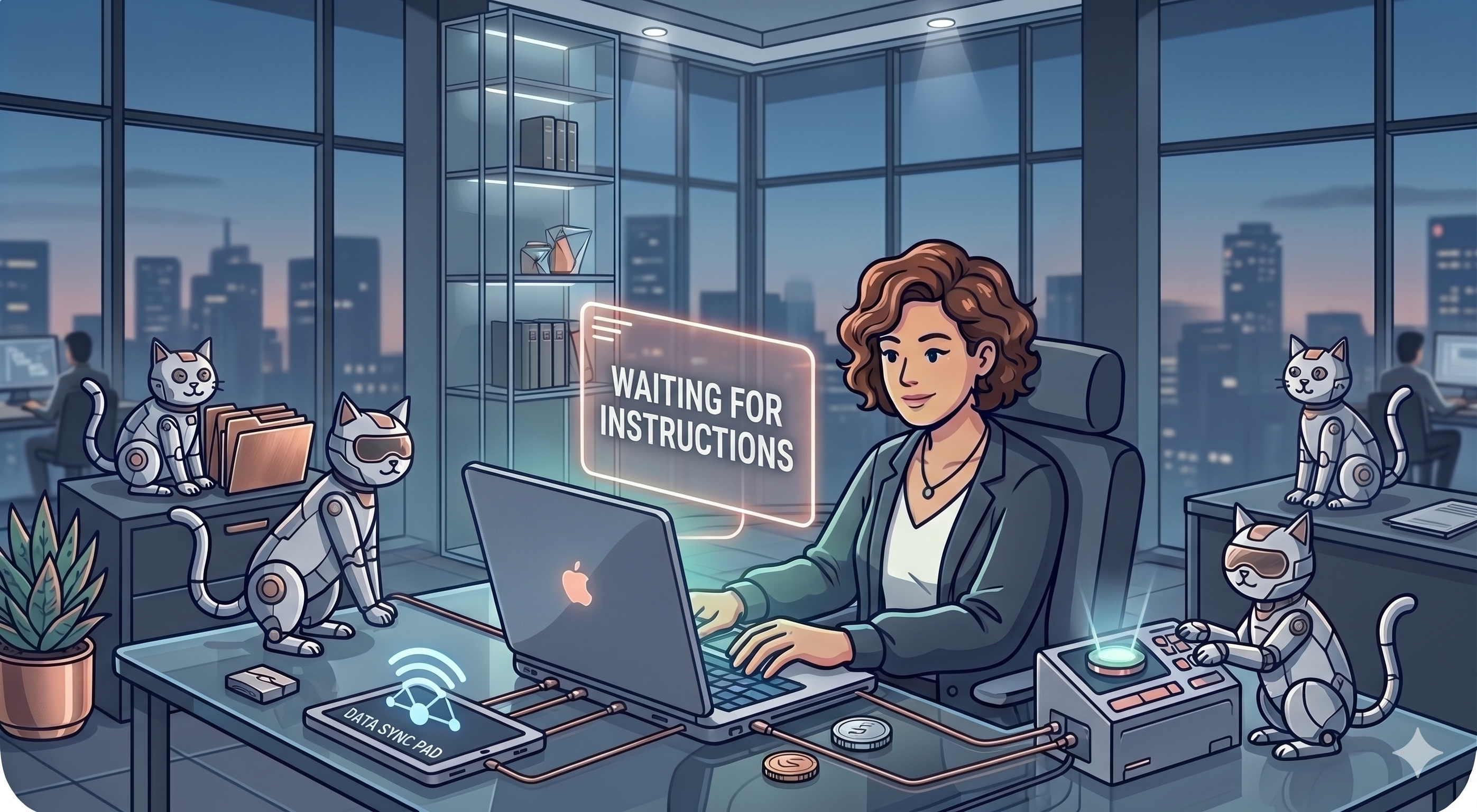
I'm being careful not to oversell this. What I can say is that the parts I've tested already change what a single person gets done in a day. And the honest bottleneck is the one in the picture above: the agents are sitting there waiting for instructions, and the slowest part of the system is me, deciding what's next.
Further reading
The Startup That Coded First and Asked Questions Later
A founder called me to make his finished product prettier. The real problem was that nobody had asked the questions that come before the code.
Fixing Your Product Operating Model Might Break Everything Else
What happens when product speeds up and nothing else does? Introducing SBOM, the Systemic Business Operating Model that keeps the organization moving.
The Bottleneck Isn't Building. It's Deciding.
AI made execution fast. But approval still runs on slide decks and steering groups. The bottleneck in product development isn't technical — it's organizational.
Get the next article in your inbox
Short, practical notes on strategy, operating models, and what it takes to turn intent into something that actually works.