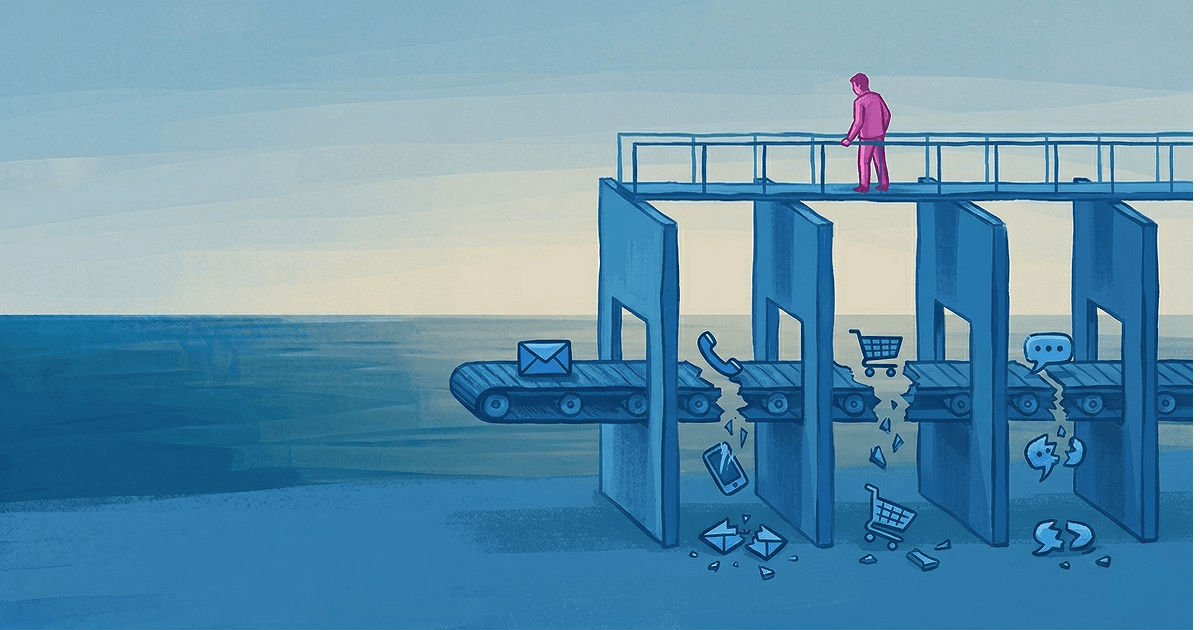
Well-run silos, broken handovers. That's what the customer actually experiences.
Everyone talks about customer experience.
Open any strategy deck from any mid-to-large organization and you'll find it mentioned somewhere. "We put the customer first." "Customer experience is at the core of everything we do." "We offer the best customer experience." Most organizations have someone with CX in their title, sometimes a whole team. They run NPS programs, map journeys, collect customer insight and publish reports measuring customer satisfaction. The intent is real.
And still, the experience customers actually get doesn't match the ambition.
I've seen this pattern across industries for over a decade. The CX team works hard, they produce good insight and identifies real friction points. Then the recommendations land on the desks of people who have their own KPIs, their own budgets, and their own priorities. Nothing happens. Or it can be that something small happens, but the structural issue remains untouched.
The reason is simple: CX is cross-functional by nature, but almost always nobody has the mandate to lead it that way.
Everyone talks about CX. Seldom somebody owns it.
Ask a leadership team whether customer experience matters. Every hand goes up. Ask who's responsible for the end-to-end experience, from the first touchpoint through onboarding, service delivery, support, and renewal. That's where it gets quiet.
Customer experience forms in each of the touchpoint between your organization and the customer whether you manage it or not. At each touchpoint you either build or destroy the experience. Every handover between teams, every system boundary, every policy decision two levels above the front line shapes what the customer actually experiences. If nobody is deliberately steering that, it's being shaped by accident. It's shaped by org chart boundaries, by budget cycles and by whoever happened to own the last ticket.
Competition between companies is, at the end of the day, competition between customer experiences. Products are easy to copy especially now in the age of AI, copying the experience is lot more harder. Your competitors aren't standing still. If your CX is being shaped by accident, you're falling behind on purpose.
Talking about CX in strategy decks without leading it systematically is decoration. It makes people feel good, but it changes nothing for the customer.
CX is always cross-functional. That's why it breaks.
The customer journey cuts across marketing, sales, product, operations, support, IT, and usually a few more functions depending on the industry. Each function optimizes its own piece. Sales optimizes conversion, product ships features,and support gets response times down. Good work, all of it, inside each team's boundaries.
Nobody optimizes the seams between them.
This is something I keep coming back to. Your customer experience reflects your organizational structure, not your strategy deck. If your organization is built in silos, the customer gets a siloed experience. Regardless of how friendly and competent each silo is individually.
Where does CX consistently break down? It breaks down at ownership boundaries, at system transitions and at handovers where "that's not my area" lives. A customer starts a process in one channel, continues it in another, and the context disappears because the two systems were built by different teams with different priorities in different years.
The individual interactions can be excellent. The overall experience can still be fragmented. That's the paradox most CX programs struggle with: they optimize the parts but never fix the connections between them.
Why a CX department alone doesn't solve this
Creating a CX team signals that the organization cares. I'm not dismissing the intent. But it also signals something else: that CX is now someone else's job.
Once there's a CX department, it sometimes go that every other function can treat customer experience as optional. "We have a team for that." Product goes back to the roadmap, operations goes back to efficiency targets, sales goes back to the pipeline. And the CX team sits in between, producing reports that accurately describe problems it has no authority to fix.
The CX department absorbs complaints, measures satisfaction, runs workshops, maps journeys. What it rarely has is the authority to change the processes, systems, or structures that create the problems in the first place.
This is the distinction that matters: managing CX and leading CX are two different things.
Managing CX means measuring satisfaction scores, training frontline staff, improving scripts, running loyalty programs. That's maintenance work, and it has value. But it only works at the edges. It polishes the surface without touching the structure underneath.
Leading CX means defining what customers should experience end to end, tracing which processes and structures create or prevent that experience, and making changes at the root. Changes that may be uncomfortable because they cross functional boundaries and challenge how teams have always worked.
A CX team without cross-functional mandate is a reporting function, not a leadership function. And if all you have is a reporting function, don't be surprised when the reports keep saying the same things year after year.
What systematic CX leadership actually looks like
So what does it look like when CX is actually led, not just managed?
It starts with someone who has the mandate to look across functions and make decisions that prioritize the end-to-end customer outcome over individual team goals. This sounds obvious when you write it down. In practice, it's rare.
Most organizations are optimized for functional accountability. Each leader is responsible for their piece. When a CX problem sits between two functions, neither leader feels ownership. The CX team identifies it, reports it, maybe even proposes a solution. But the solution requires changes in two different budgets, two different roadmaps, and two different leaders' priorities. Without someone who has the authority to broker that, nothing moves.
Systematic CX leadership means three things:
First, mandate. The person leading CX needs the organizational authority to work across functions, not as a facilitator who asks nicely, but as someone whose decisions carry weight. When the end-to-end customer outcome conflicts with a single team's local optimization, someone has to make the call. If nobody can, the local optimization wins every time. And the customer loses.
Second, budget. CX problems that live between functions don't get fixed with any single function's budget. The pain shows up in support, but the root cause lives in product or operations. If the CX leader doesn't have budget to invest in cross-functional fixes, they're dependent on convincing each function to spend their own money on someone else's problem. That's a slow, political process, and it usually fails.
Third, the ability to override local optimization when it creates friction downstream. This is the uncomfortable part. A product team might ship a feature that makes their metrics look great but creates a wave of support contacts. An operations team might cut a process step that saves them time but breaks the customer's experience at a critical moment. Systematic CX leadership means someone has the authority to say: the overall outcome matters more than your local metric.
I'm not arguing for a CX dictator. But let's be honest: this same problem exists on the business side too. In most organizations, only the CEO is truly accountable for the whole. Everyone below optimizes their own vertical. The business leaders do it with revenue and operations. CX just makes the gap more visible because the customer feels it directly. If your business already struggles with cross-functional coordination, adding a CX mandate on top won't magically fix it. But it's a good place to start, because the customer experience is where the cracks show up first.
The first step: make the real picture visible
Before you can lead CX systematically, you need to see the whole picture. Not the journey map that was produced in a workshop where each team presented their own view. The real picture, from the customer's perspective.
Most organizations already have journey maps. Many of them are good, mapped from the customer's perspective, sometimes even connected to real feedback data and analytics at each touchpoint. The problem isn't the map. The problem is that the map shows friction nobody has the mandate to fix.
A real starting point: follow one end-to-end customer journey with a cross-functional team. No filters. No defensive framing. Start from what the customer does, not from what your process says they should do. Track every handover. Note every point where context is lost, where the customer has to repeat themselves, where the experience fragments.
What you'll find, almost certainly, is friction that everyone knew about individually and nobody was responsible for collectively. Pain points that have been on someone's list for years but never got fixed because fixing them required coordinating across three teams with no shared mandate.
Once that picture is visible, the conversation changes. It's no longer about whether CX matters. It's about who has the mandate to fix what everyone can now see. That's the question that determines whether your CX programs produce real change or just produce reports.
This isn't a CX team problem. It's a leadership model problem.
Most organizations are built around business verticals. Meaning revenue lines, product areas, and functional departments. The entire leadership model, budgeting, accountability, and decision-making, runs vertically. But the customer experience runs horizontally, across all of those verticals, through handovers and system boundaries that no single vertical owns.
That's the structural mismatch. You have a horizontal customer journey governed by a vertical operating model. The CX team sees the friction, but fixing it requires someone with the mandate, budget, and authority to act across the verticals. Without that, every improvement stays local and the end-to-end experience stays fragmented.
Customer experience has to be led. Systematically, cross-functionally, with real authority. Until your operating model reflects that, the gap between your CX ambition and your customer's actual experience won't close.
I'm Jenni. Most strategies stay vague, and most AI starts from the tech. I start from where the business actually makes money: mapping where it grows or leaks, designing how it should run, scoring what's worth building, and building the working tools that make it real. Founder of Digital Rebel, a Transformation Studio.