Finnish Financial Group
Operating Model Redesign for Cost Efficiency in a Finnish Financial Group
Client
Finnish Financial Group
Industry
Financial / Insurance
Services
Transformation Design, Transformation Lead
Challenge
The situation
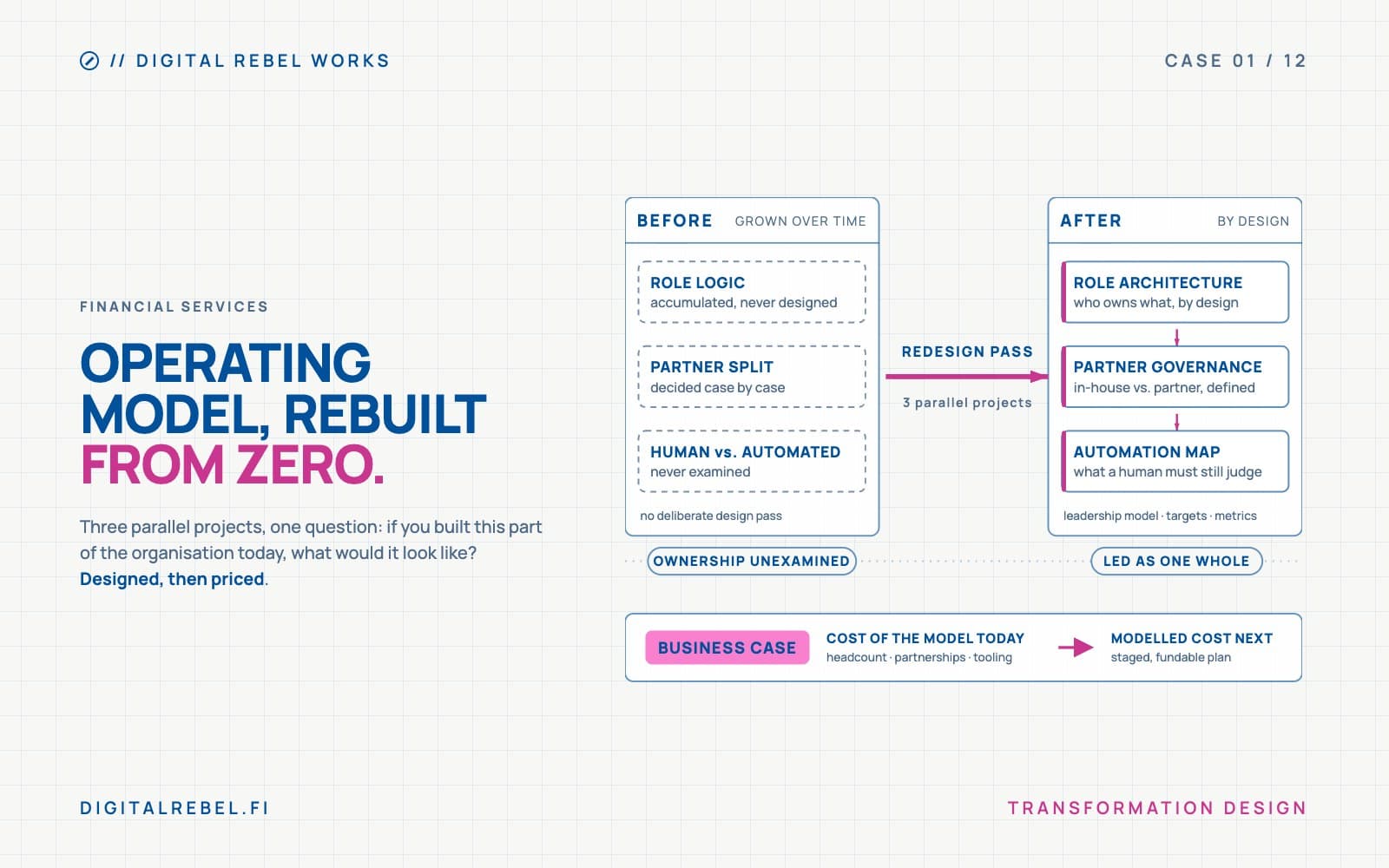
A Finnish financial group launched three concurrent operating model redesign projects driven directly by corporate strategy and leadership decisions. The mandate was to reduce costs and improve efficiency — not by optimizing the edges, but by rethinking how the organization was structured from the ground up. The core question was deliberately fundamental: if you were building this part of the organization from scratch today, what would it look like? Existing structures had accumulated over time without a deliberate design pass, and neither the role logic, the partnership model, nor the division between human and automated work had ever been examined systematically.
Approach
What we did
Digital Rebel took on Business Development Product Lead responsibility across all three projects. The work covered the full scope of operating model redesign for a defined organizational area: org structure, leadership model, roles, and job descriptions built around the new way of working. We mapped how the area connected and handed off to other parts of the organization, and designed the governance model for external partnerships — what would be owned in-house and what would be delivered by partners. Alongside the structural work, we defined targets, metrics, and how performance would be led and tracked in the new model — creating a concrete reference for management, hiring, and quality assurance. The design included a forward-looking assessment of automation and AI readiness: mapping which tasks were candidates for automation, which required human judgment, and how roles would need to evolve as AI took on routine and analytical work. This shaped both the role architecture and the sequencing of change. A business case was built comparing the cost of the current operating model against the redesigned one — covering headcount, partnership costs, tooling, and projected efficiency gains. This gave leadership a clear financial basis for approving and funding the new model.
Results
Where it landed
By the end of the engagement, leadership had a complete decision package in hand: the redesigned operating model with role architecture, leadership model, and partnership governance, plus a business case comparing the current and future cost structure across headcount, partnerships, and tooling. The automation and AI readiness map gave a concrete sequence for how roles evolve as routine work is automated, turning "restructure someday" into a fundable, staged plan.