AI Portfolio
Wealth Analyzer
The net-worth tool no bank would build for me, so I built it myself
The Problem
Too many strategies, too many accounts, no single view
A full walkthrough of the app, shown entirely in demo mode with a fictional Finnish portfolio.
My biggest pain as an amateur investor is that I follow too many strategies at once. Each one spawned its own investment account with its own service provider, so my money ended up scattered across several places that don't talk to each other.
The predictable thing happens: I drift. I know I should be rebalancing and keeping the strategy straight at the portfolio level, but there was never one place that showed me the whole picture, let alone told me what was off track.
The bigger frustration is that nobody sells the fix. At least in Finland, none of the providers offer a net-worth or wealth-analyzer tool for individual investors, and there are no APIs to pull your own investment data out either.
So instead of holding my breath waiting for a bank to build it, I built the whole thing myself with Claude Code and the new Fable model. It's a desktop app, local-first by design: it runs on my own machine and the data never leaves it.
What it does
One app, from "where am I going" to "what do I do next"
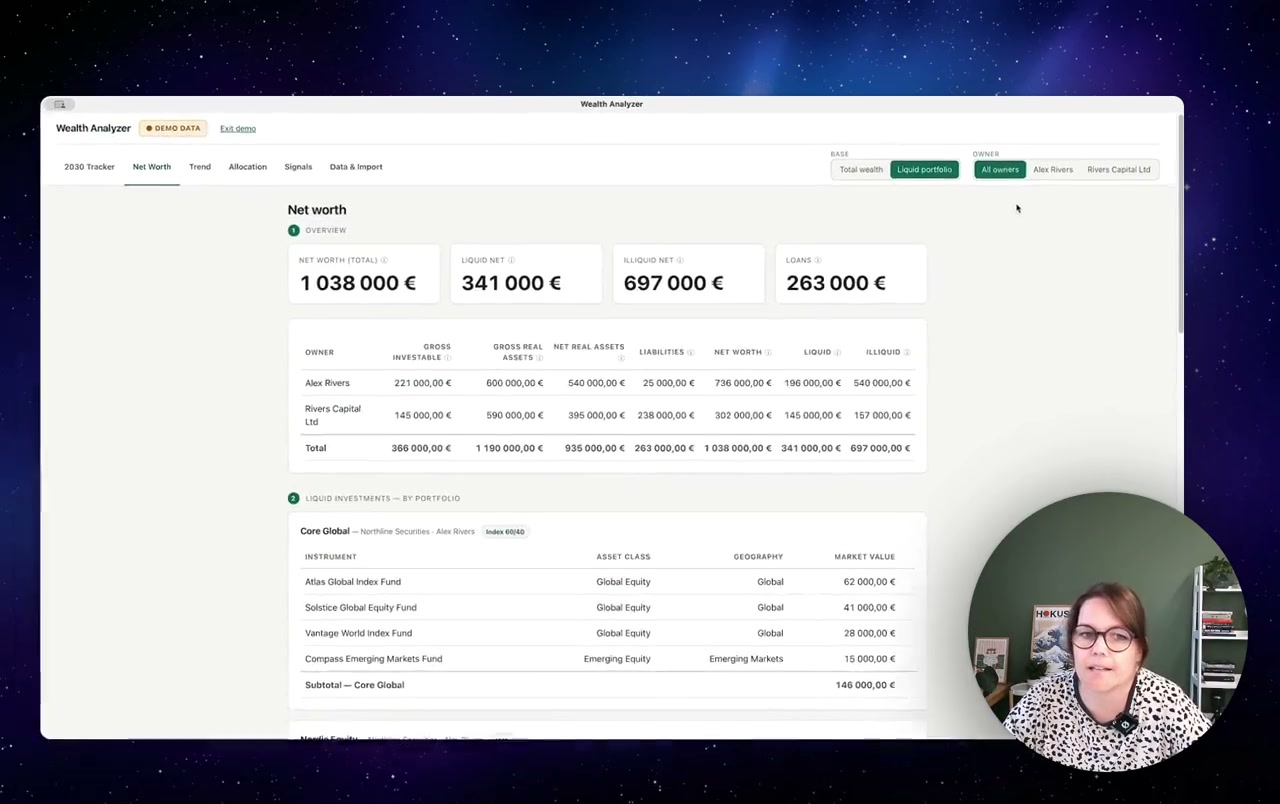
The app is organised as six views. The first three answer where I'm heading.
- 2030 Tracker models financial freedom across base, optimistic and pessimistic scenarios. It shows the target capital I'd need, my current capital, the safe withdrawal rate, and the year I'd actually get there, with a calculator to test "what if I invested harder from here?"
- Net Worth rolls up total, liquid and illiquid net worth and loans, broken down by portfolio, asset class, geography and market value, including real assets like an apartment or summer cottage.
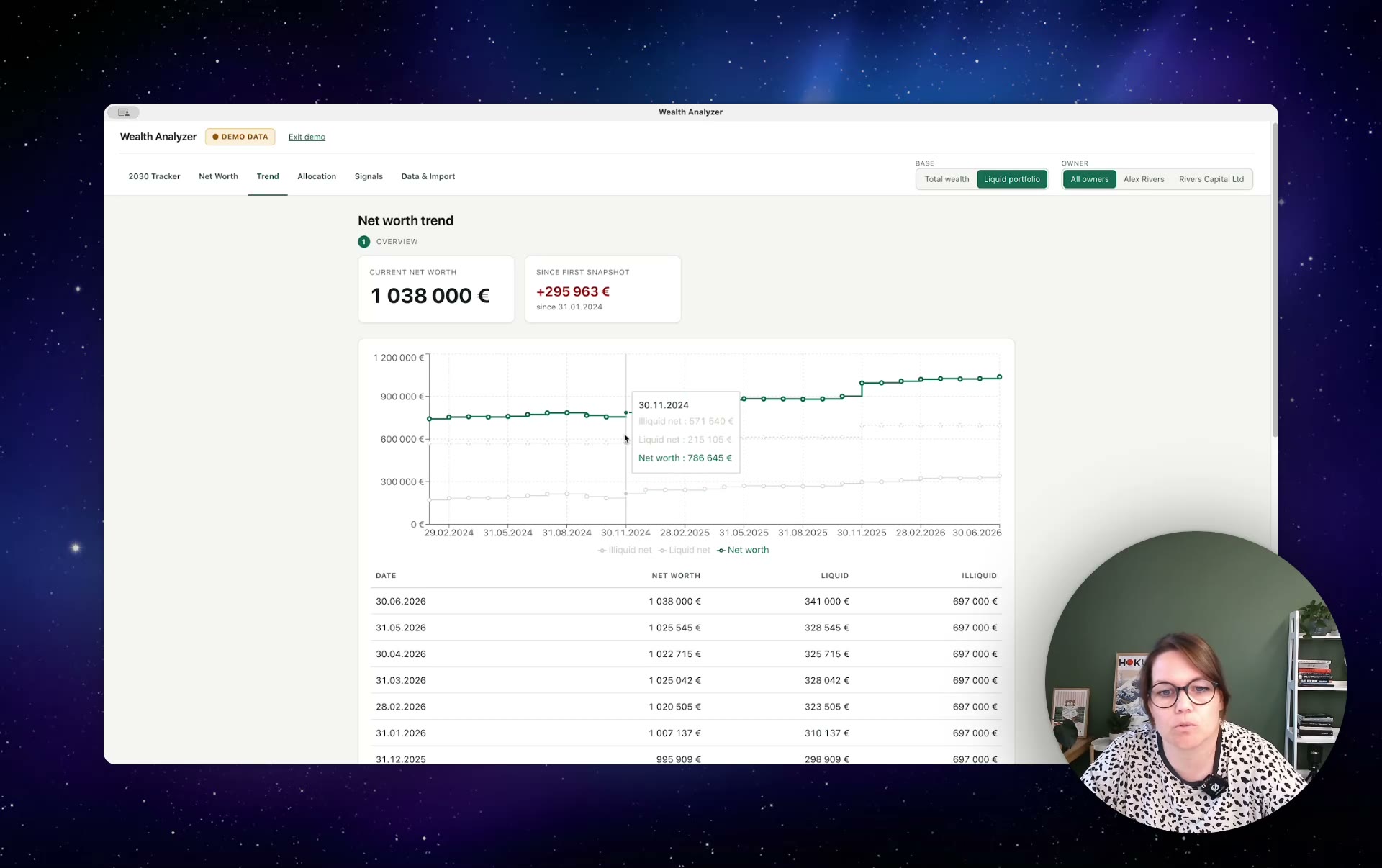
- Trend tracks whether net worth is climbing or sliding over time, built from each data import as a snapshot.
The last three views answer what to do about it.
- Allocation compares my actual mix against the targets I set in the app's own settings, per asset class, and flags which allocations are on target, under target or drifting.
- Signals turns that into a plain to-do list: rebalance this, top up that, so I know the concrete next action instead of a vague feeling that something's off.
- Data & Import is where new numbers come in.
Because I'm a solo operator, every view can be sliced by owner, my personal side and the company side, so I can look at total wealth or just the liquid portfolio, for one owner or all of them.
Under the hood
Local-first, and the import is the clever part
There's no API to pull investment data from Finnish providers, so import is manual on purpose. But it's the step I worked hardest to make frictionless: I copy whatever my portfolio page shows and paste the whole messy block in. The app keeps the holdings and throws away all the noise the website wraps around them. Working out that parsing logic was where I used Fable, but it's baked into the app now, so at import time it's just local code running, no model call. Start to finish it's about a minute.
Everything downstream is derived from those imports. The targets live in the app's settings, so Allocation and Signals aren't guessing, they're comparing my real mix against the strategy I defined and telling me where it has drifted.
It's a desktop app and it's local-first, and that was a deliberate call for something as personal as your finances. When it opens it offers two ways in: load my own data, which stays on the machine and never gets sent anywhere, or a read-only demo with a fictional Finnish portfolio that saves nothing. Everything in the walkthrough above is that demo mode.
The build
- A desktop app built with Claude Code and the Fable model, packaged with Tauri
- Local-first: data stays on my machine, nothing is uploaded
- Fable was used to design the paste-to-structured-data parsing, which then runs as plain local code, no model calls while I use the app
- Owner and base filters (personal vs. company, total vs. liquid) across every view
- A demo mode so I can show the tool without showing a single real number
Where I Am Now
Live for me, and honest about the manual step
Honest status, same as everywhere else on this site.
Live and running
- All six views work end to end: 2030 Tracker, Net Worth, Trend, Allocation, Signals, Data & Import.
- Personal and company sides in one place, filterable by owner and by total vs. liquid.
- Rebalancing signals generated from the targets I set, so drift becomes a concrete to-do.
- Demo mode with a fictional portfolio, which is how I can share it at all.
Not there yet
- The import is still manual. Nobody exposes an API, so I paste and parse. Fast, about a minute, but not automatic, and that's the honest ceiling until providers open up.
- It's a single-user tool I built for myself, not a product. It does exactly what I needed and no more.
The real point isn't the app. It's that the gap between "a bank should build this" and "fine, I'll build it this weekend" has basically closed. When I know exactly what I want and nobody sells it, I don't have to wait anymore.
Tech Stack
- Claude Code — build and orchestration
- Tauri — packaged as a native desktop app
- Fable model — used at build time to design the import parsing logic
- Local-first storage — data never leaves the machine, no model calls at runtime
- Trajectory and trend charts
- Demo mode with a fictional Finnish portfolio
Further reading
The Startup That Coded First and Asked Questions Later
A founder called me to make his finished product prettier. The real problem was that nobody had asked the questions that come before the code.
The Bottleneck Isn't Building. It's Deciding.
AI made execution fast. But approval still runs on slide decks and steering groups. The bottleneck in product development isn't technical — it's organizational.
Growth, Growth, Growth — But From Where, Really?
Before you push growth harder, look at how buying actually works from the customer's point of view. Growth doesn't fix friction — it scales it.
Get the next article in your inbox
Short, practical notes on strategy, operating models, and what it takes to turn intent into something that actually works.