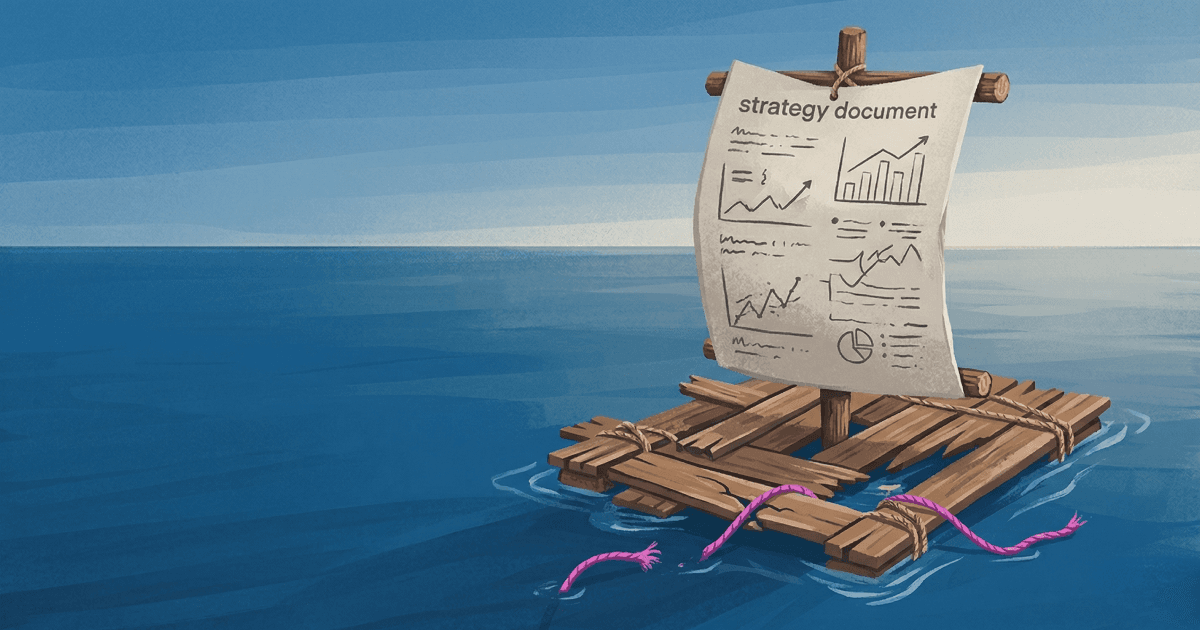
Most organizations I've worked with have a strategy document. Very few have an actual strategy. And almost none have an operating model designed to carry it.
Strategic clarity at the top, or what passes for it, and structural confusion everywhere else.
The gap between boardroom intent and Monday morning reality is not a communication issue. It's an organizational design problem, the part nobody touches.
The pattern: strategy changes, structure doesn't
Most transformations start the same way. There are x number of strategy workshops, new priorities are decided, and a roadmap. Maybe also a new vision statement.
What stays untouched is the org chart with same budget structure, and same decision paths are expected to carry the new direction. Within months, the new strategy is running on old rails.
I saw this clearly in a financial services organization. They declared "customer-centric" as the strategic focus area. Workshops were run, but every budget line was still tied to functional KPIs. Nobody owned the cross-functional customer journey. Three years later, they still weren't customer-centric, and the reason was simple: the structure funded and rewarded something else entirely.
This is the norm, not the exception.
When strategy changes, most organizations update the slides and the talking points. Almost nobody redesigns the decision rights, the ownership model, or the way money flows between teams. And then everyone wonders why execution feels stuck.
Why the response is always "more communication"
When strategy doesn't land, the reaction is predictable. We need town halls, OKR workshops and more alignment meetings. A communication cascade where each level repeats what the level above said, with a bit less conviction each time.
The assumption is always the same: people aren't aligned. If we just explain the strategy better, things will start moving.
But strategy execution as a discipline barely exists in most organizations. Nobody's job is to look at the structure and ask: does this support the direction we've chosen? Nobody owns the translation from strategic intent to structural change. So the response defaults to the only tool people know: more meetings, more slides, more communication.
The operating model is invisible precisely because it's everywhere. People live inside it. They experience its effects every day, in every slow decision, in every handover that goes nowhere, in every meeting that exists because nobody is sure who's supposed to decide. But they can't see it as a thing that was designed, or more often, that wasn't designed at all.
What the operating model actually controls
When I say operating model, I don't mean the org chart. The org chart tells you who reports to whom. The operating model tells you how the organization actually works. Or doesn't.
I break it down into four layers. Each one either enables or blocks the strategy.
Decision rights. Who decides what, and how fast. If your strategy requires speed to market but every product decision needs three committees, the operating model is working against the strategy. Decision rights are the most underrated structural element. Get them wrong and everything slows down, regardless of how talented the people are.
Information flow. Who knows what, and when. If your strategy requires cross-functional collaboration but each function only sees its own data, people can't collaborate even if they want to. Information doesn't flow by accident. It flows through designed channels, and most organizations haven't designed these for their current strategy.
Resource allocation. Where money and people go. This is where most strategies quietly die. The strategy says "customer-centric" but the budget funds functions, not customer journeys. The strategy says "innovation" but every person is allocated to maintaining what already exists. Budget structure is the most honest expression of what an organization actually prioritizes, regardless of what the strategy deck says.
Coordination mechanisms. How teams work across boundaries. Handovers, feedback loops, escalation paths, shared goals. This is the connective tissue between functions. When it's missing, you get individually strong teams and a collectively slow organization. Each team optimizes for their own part. Nobody optimizes the whole.
Go back to "customer-centric" as a strategic direction. To make it real, you need decision authority closer to the customer. You need information flowing across the full journey, not trapped inside functions. You need a budget that funds cross-functional work. And you need coordination mechanisms that connect sales to onboarding to support to product. Touch only one of these and the other three pull you back.
What a Targeted Redesign looks like in practice
I run a diagnostic called a Targeted Redesign. It maps the gap between stated strategy and actual structure.
The process is collaborative. I work with people across the organization, not just leadership, because the gap between intent and reality is best understood by the people who live inside the structure every day.
The output is a working document, not a 200-page consulting report. It tells leadership where the structural bottlenecks are, what's causing them, and what to change first.
Three questions to ask this week
You don't need a consultant to start seeing this. Three questions will take you surprisingly far:
Can you trace a line from your strategy to a specific structural decision made in the last six months? Not a communication decision. A structural one. A change in who decides what. A change in how budget is allocated. A change in who owns a cross-functional outcome. If you can't find one, the strategy hasn't reached the structure yet.
When something is "everyone's responsibility," who actually moves it forward? Customer experience is a common example. Everyone agrees it matters. Nobody has the authority to change the handovers between departments that shape it. "Shared responsibility" usually means nobody moves. And that's by design, even if nobody designed it consciously.
Does your budget structure fund the work that happens between functions, or only within them? Most budgets fund functions. Sales has a budget. Product has a budget. Operations has a budget. But the handover from sales to onboarding? The feedback loop from support to product? The translation from strategy to what operations actually does on Monday? Nobody budgets for those. So nobody fixes them.
If these questions are hard to answer, that's usually the first sign the operating model needs attention.
I'm Jenni. Most strategies stay vague, and most AI starts from the tech. I start from where the business actually makes money: mapping where it grows or leaks, designing how it should run, scoring what's worth building, and building the working tools that make it real. Founder of Digital Rebel, a Transformation Studio.