
I started my career over 20 years ago as a UX designer. One of my first big projects was to conceptualize and design a totally new service called Mobile TV. We lived in the GSM era back then, and my employer was investing millions building an entire network infrastructure to support the service because mobile networks simply weren't ready for video streaming.
My job was to design the service — the whole UI, interactions, navigation, special cases, error cases — and make it usable. The usual things UX involves.
What I didn't see, because no one had taught me to see it, were all the layers outside the product itself: technology constraints, business assumptions, market readiness, timing.
The service we designed and built was good, but it didn't become a commercial success because of invisible forces I wasn't even aware of. Eventually the whole program was discontinued because it wasn't viable.
Fast forward to 2026.
After two decades in digital business and product development, strategy, and large-scale transformations, I've lived inside many different bubbles: product, design, tech, CX, and also business.
Over time, my perspective has expanded from product level to system level. From "what are we building" to "why is this happening in the first place."
Our daily lives are affected by forces we might not even recognize. Most of us only see a small slice of the bigger picture, when in fact everything is somehow connected to everything. This text is about that bigger picture, and the layers most of us don't see but still work inside every single day.
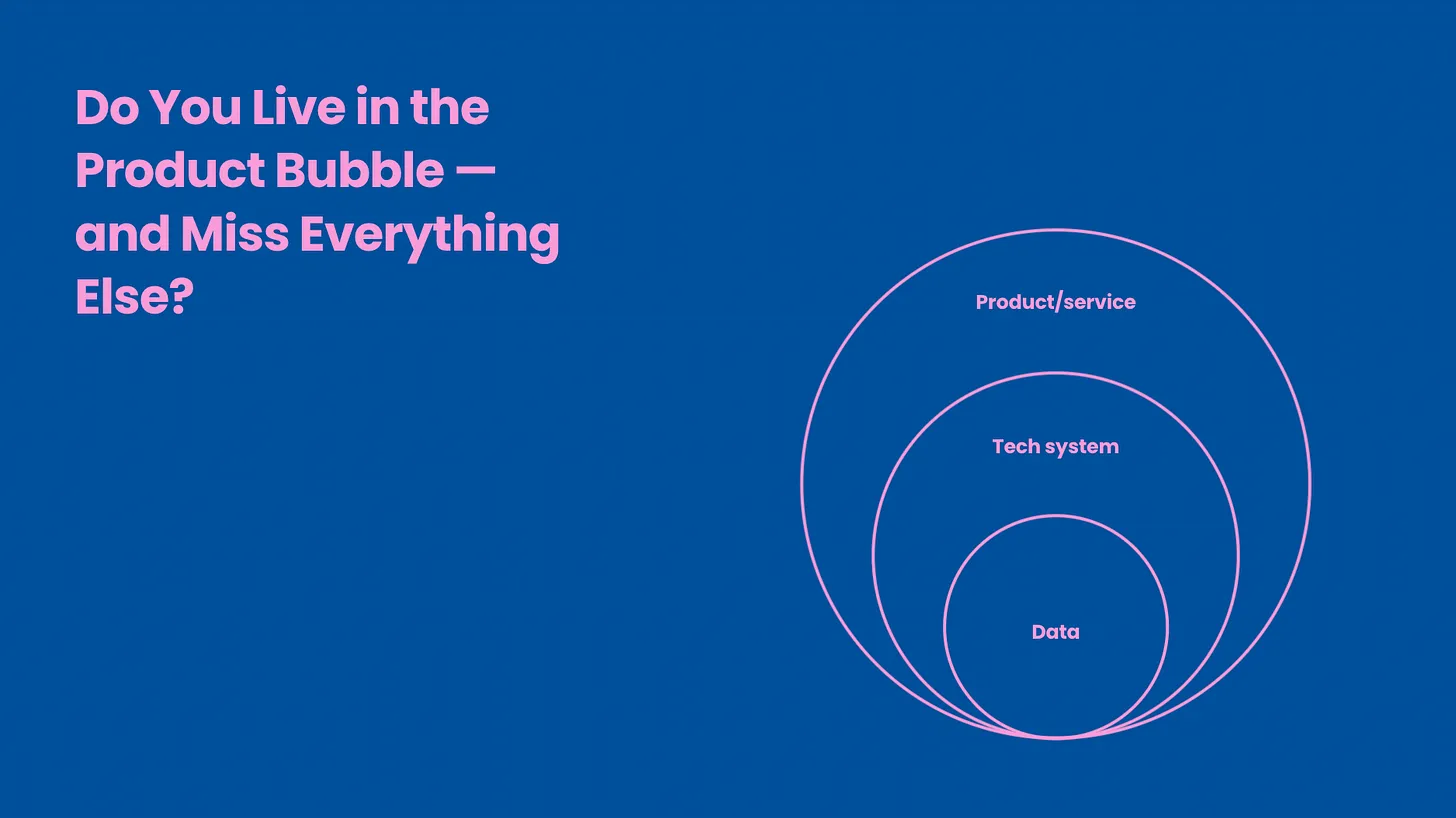
Do you live in the product bubble — and miss everything else?
A lot of people live in the digital work context and see three layers only: data, tech systems, and product or service. But businesses don't operate in only those three layers. What's really going on is much bigger, and much messier.
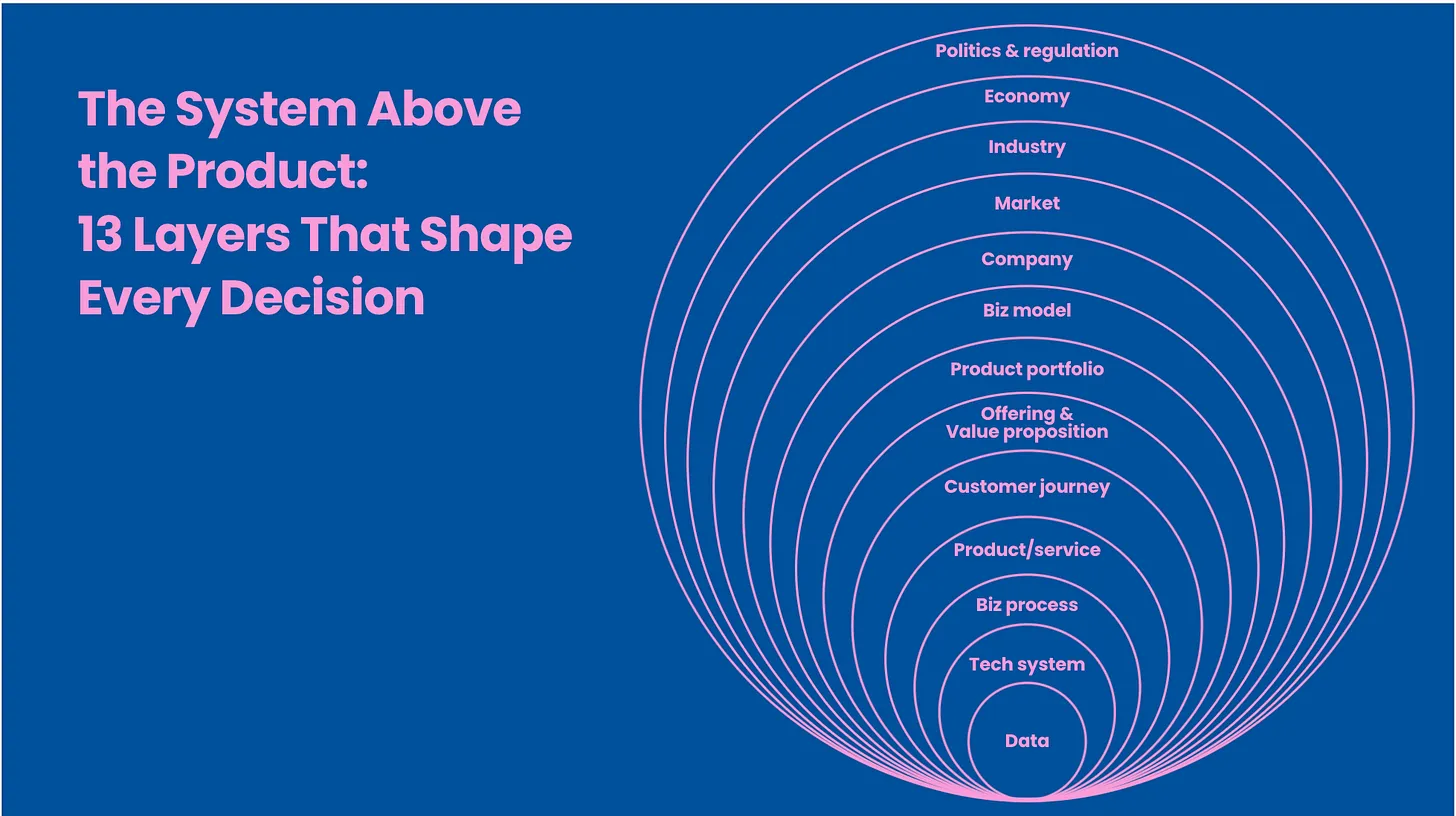
The system above the product: 13 layers that shape every decision
Instead of three layers, there are thirteen. Stacked inside each other. From raw data at the core, all the way out to politics and regulation at the edge.
So let's zoom out and walk through them.
1. Data
At the center of everything is data. Not just quantitative numbers in dashboards, but also qualitative data: how customers feel, what their motives and goals are, how they behave, what they complain about, what they avoid. If you've ever done user research, you've worked with this layer too. Data is the raw material. Without it, there's nothing to learn from and nothing to improve. Every system, every process, every product decision starts here. If your data is biased, incomplete, or just wrong, everything built on top of it will be off as well. Strategy included.
2. Tech systems
Next come the tech systems. These are the platforms, tools, and digital infrastructure that turn data into action. CRM systems, core systems, analytics tools, automation platforms. The choices companies make here matter a lot, even if they don't look exciting. Systems shape how flexible you can be, how quickly you can move, and how painful change becomes later on. They're the machinery running the business in the background — powerful, mostly invisible, and notoriously hard to replace once they're in place.
3. Processes
Then we get to processes. These are the repeatable ways work gets done for things like customer lifecycle stages, sales, or customer support. Processes run on systems and depend on data. You can think of them as a company's everyday habits. When those habits are messy or unclear, everything slows down. Work takes longer than it should and progress feels heavy.
When things make sense, work flows more naturally and value actually moves forward. It's not just about efficiency — these habits quietly shape how a company grows and what it feels like to deal with them as a customer.
4. Product or service
On top of that sits the product or service. This is the visible part, the thing customers pay for. But it's really just the surface. What people see is the result of all those invisible layers underneath working together, or not. A product isn't just a bundle of features. It should solve a specific problem in a specific way, for a specific group of people.
5. Customer journey
Above the product is the customer journey. This is the full story from the customer's point of view: finding you, buying from you, using the product, getting help, and eventually leaving — because every relationship ends at some point. The journey cuts across many layers and internal functions at once, and this is where friction shows up. Small issues here often decide whether customers stay or walk away. And yes, that hits revenue directly.
6. Value proposition and offering
Then comes the value proposition and offering. Customers don't really buy products. They buy promises. A mix of product, price, brand, support, and expectations. This layer answers a simple but brutal question: why should anyone choose you instead of someone else? Every value proposition is a strategic choice, whether you realize it or not.
7. Portfolio
Zoom out again and you'll see the portfolio. This is the collection of everything the company offers, all products and all services. Portfolio decisions are where strategy becomes real. What gets funding, what gets attention, what gets shut down. Saying no here is just as important as saying yes.
8. Business model
Next is the business model. This is how the company actually makes money. Who pays, how money flows in, where costs go out, and what needs to scale for the business to survive. You can have a great product and happy customers, and still fail if the business model doesn't work. This layer turns strategy into financial reality.
9. Company
Then there's the company itself. The people, the culture, the skills, the leadership, the strategy, the brand. This is the engine that runs the business model. Decisions are made here, priorities are set here, and trade-offs happen here. What the company believes in, and what it avoids, defines what's even possible.
10. Market
Beyond the company sits the market. This layer includes competitors, demand, pricing pressure, and customer expectations. This is where ideas meet reality. The market doesn't care about your internal struggles. It reflects back what customers are willing to pay for. Understanding the market is less about analysis and more about positioning: where do you compete, and why should you succeed there?
11. Industry
Zoom out further and you hit the industry. Industries move slower than markets. They have structures, power dynamics, and unwritten rules. It's about supply chains, regulators, and dominant players. Some companies just compete inside an industry. Others manage to reshape it. That's a strategic difference.
12. Economy
Above that is the economy: interest rates, inflation, consumer confidence, investment cycles. When the economy shifts, everything underneath feels it, even the best-run companies. Strong strategy doesn't ignore the economy. It plans with it in mind.
13. Politics and regulation
And finally, the outermost layer: politics and regulation. This layer covers laws, policies, taxes, trade agreements, and geopolitics. These set the rules everyone has to play by, and those rules change — sometimes slowly, sometimes overnight. We've all experienced this layer lately as tariff threats create uncertainty in global markets. This layer can block entire business models or suddenly create new opportunities.
How to make sense of 13 layers without losing your mind
Thirteen layers can sound like a lot. And honestly, no one goes through their day actively thinking about all of them at once.
So instead of trying to keep everything in your head, it helps to simplify the picture. One way to do that is to group the layers into four bigger chunks.
1. Enablers
At the bottom are the enablers: data, tech systems, and processes. Customers almost never talk about them, and that's exactly how it's supposed to be. They stay out of sight, doing their job in the background.
But they quietly set the boundaries for what's possible. And when these foundations aren't solid, everything built on top of them starts to wobble, no matter how good the ideas are.
2. Customer-facing layers
Then come the customer-facing layers: the product, the journey, the value proposition. This is what people actually experience. This is where trust is built or lost. But none of it works in isolation. What customers feel is always shaped by what sits underneath.
3. Strategic direction
Above that is strategic direction. Portfolio choices, business model decisions, and company direction. This is where bets are placed. What to invest in, what to stop doing, what really matters this year and what doesn't. Many people never get visibility here, but this layer steers everything below it.
4. External constraints
And finally, there are the external constraints. Markets, industries, the economy, and politics. You can't control these as an individual, but they shape the rules of the game. Sometimes slowly, sometimes overnight. Ignore them, and even the best execution won't save you.
In summary: enablers hold everything up, customer-facing layers shape what people feel, strategic direction shapes what the company focuses on and what it ignores, and external forces draw the boundaries.
Systems thinking is about seeing how everything is connected
With my current understanding, starting a similar kind of project to Mobile TV would be a totally different kind of experience. Today I would start by asking questions before building anything, especially on the business side, to make sure there's actually a valid business model.
Building is easy. Even meeting customer needs is easy. Building a profitable business — that's the hardest part. So it's crucial to understand the bigger context and how everything is connected and affecting each other.
Thinking in systems doesn't mean you need to master all thirteen layers. It simply means you stop seeing your work as isolated. The more layers you can see, and the more connections you can make between them, the more impact you can have. Not by doing more, but by understanding better.
And that's really what systems thinking is about.
I'm Jenni. Most strategies stay vague, and most AI starts from the tech. I start from where the business actually makes money: mapping where it grows or leaks, designing how it should run, scoring what's worth building, and building the working tools that make it real. Founder of Digital Rebel, a Transformation Studio.