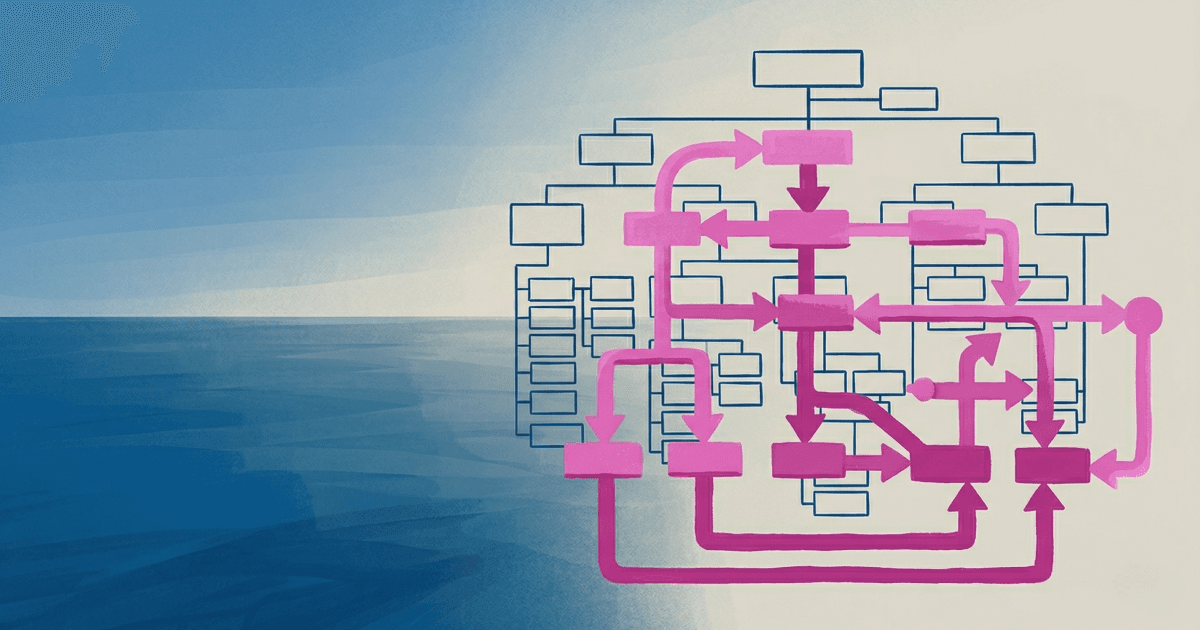
Every organization I work with has a strategy. Most of them also have a budget process that quietly overrides it.
Here's how it usually goes. Leadership sets a direction. Better customer experience. Best sales year ever. A major core system renewal. Then the budget cycle starts. Every function gets a line. Every team optimizes within it. And the work that spans multiple functions, the handovers, the cross-team decisions, the feedback loops that should connect sales to product to operations, gets no line at all.
Not because anyone decided it wasn't important. Just because it doesn't fit in the structure.
The result is something I see over and over: individually strong functions and a mediocre business overall. Everyone is working hard inside their part. Nobody designed how the parts connect.
Budgets shape behavior more than strategy decks
This isn't really about budgets. It's about what budgets reveal.
When a company allocates money function by function, it sends a clear signal about what matters: your part. Your team's goals. Your department's KPIs. The things you control. That's what gets measured, and that's what gets fixed when it breaks.
The work between functions doesn't have that same gravity. There's no "cross-functional handover" line in anyone's budget. There's no KPI for "how fast does information travel from support to product to operations." When that path breaks, it shows up as delays, duplicated effort, and customers who feel the friction before anyone inside the organization even notices.
I worked with a financial services organization where the lending process crossed five teams. Each team had optimized their own part. Response times inside each function were fine. But the customer waited weeks from application to decision because nobody owned the flow between teams. The five budget owners had five sets of priorities, and the actual customer experience fell between all of them.
That's not a people problem. Everyone was doing their job. It's a design problem. Nobody designed what happens between the teams.
Operating model is not one thing
Part of the confusion comes from the term "operating model" itself. People use it to mean very different things depending on where they sit.
A team lead thinks about how their team works. Roles, rituals, tools, ways of working. That's a team-level operating model.
A product leader thinks about how they build and ship things. Discovery, delivery, decision-making within the product function. That's what people usually mean when they say product operating model, or POM.
But neither of those describes how the entire business works as a connected system. How strategic priorities translate into what each function actually does differently. How information moves between teams. Who resolves trade-offs when product wants one thing and sales needs another.
That system-level view is what I've started calling SBOM, Systemic Business Operating Model. I wrote about the concept in more detail in my previous post, Fixing Your Product Operating Model Might Break Everything Else.
The short version: a POM describes how you build things inside one function. An SBOM describes how the entire organization creates, delivers, and captures value across every function.
Most companies design the first two levels and leave the third to chance. What fills that gap is years of accumulated workarounds, informal channels, and whoever happened to be loudest in which meeting.
Where the money actually disappears
When I map how work really moves through an organization, the expensive gaps are almost never inside a function. They're between functions.
The company launches a major core system renewal. IT gets the budget. They scope it based on technical requirements. But the process changes that the new system demands? Those sit in operations' budget, which was planned six months ago for something else entirely. The system goes live. The processes don't change. Everyone wonders why adoption is low.
Or marketing runs a campaign that drives a spike in leads. Great, except onboarding capacity was planned based on last quarter's numbers. Service quality drops. Churn goes up three months later. Marketing hit their target. The business lost money. Two budgets, zero coordination.
Or HR launches an employee experience program. New tools, new feedback loops, new rituals. It works inside HR's scope. But the managers who are supposed to carry it into daily work were never part of the design, because manager development sits in a different budget owned by a different VP. The program looks good on paper and changes nothing in practice.
None of these show up in a single function's budget review. They live in the spaces between, and those spaces have no owner.
The budget cycle reinforces the problem
Here's the part that makes this hard to fix. Budget planning happens once a year. Every function submits their plan. Leadership reviews, negotiates, approves. The structure of that process assumes that value is created inside functions and that coordinating between them is someone else's problem.
But whose problem is it? There's no "cross-functional operating model" line in the budget template. There's no VP of Spaces Between Teams. When someone raises the issue in a planning meeting, the usual response is "let's solve that with better communication" or "we'll set up a working group." Neither of those changes anything structural. The next budget cycle comes and the same gaps are still there, just with a new Teams channel on top.
I've seen organizations try to fix this with matrix structures, dotted-line reporting, and cross-functional squads. These help at the team level. But they don't address the fundamental question: when strategic priorities require coordinated change across multiple functions, who owns that change and where does the money come from?
Stop budgeting by function. Start budgeting by value stream.
The fix isn't better communication or another working group. It's seeing the business differently.
Most organizations are structured around functions: what sales does, what product builds, what operations runs. Budgets follow that structure. But value doesn't. A customer doesn't experience your sales function and then your onboarding function and then your support function. They experience one continuous flow, and every gap between your teams is a place where that flow breaks.
That's what value streams make visible. A value stream traces the full path from "someone has a need" to "that need is met and we captured something in return." It includes the customer's experience and your internal work. It crosses every function boundary. And it forces you to answer three questions that function-level budgets never ask: who exactly are we creating value for, how do we deliver that value end to end, and how do we capture value back?
When you draw a value stream across the lending process I mentioned earlier, you immediately see that five teams with five budgets are all working on fragments of the same flow. The customer's waiting time isn't in anyone's scope. The handover points aren't designed, they're inherited from how the org chart looked three years ago. You can't fix that inside one function's budget. You have to fund the flow.
Measure the flow, not just the functions
Function-level KPIs tell you whether each team is doing their part. They don't tell you whether the whole thing works. Marketing measures leads generated. Sales measures deals closed. Onboarding measures time to activation. But who measures the full journey from first contact to retained, paying customer?
This is where pirate metrics, the AARRR framework, are worth borrowing even outside pure SaaS. Acquisition, Activation, Revenue, Retention, Referral. Five stages that span the entire funnel. No single function owns all of them. That's exactly the point. When you measure across the full funnel, you stop optimizing one stage at the expense of the next. Marketing can't claim victory on a lead spike that tanks onboarding quality. Sales can't celebrate a deal that churns in sixty days.
The organizations I've seen do this well pick one value stream, usually the one tied to their biggest revenue source, and assign end-to-end metrics alongside the functional ones. Not instead of, alongside. The functional KPIs still exist. But now there's also a shared number that makes the gaps between functions visible. When that number drops, it's everyone's problem.
Where to start
Pick your most important customer journey. Not the one on the strategy slide, the one that actually generates most of your revenue. Map it end to end, from first touch to value captured. Include every function that touches it and every handover between them.
Then ask: does anyone own this flow? Is it funded as a flow, or is it split across five budget lines that were planned independently? Can you measure the customer's experience across it, or only inside each function?
If nobody owns it, nobody funds it, and nobody measures it, you've found the most expensive gap in your organization. And no amount of alignment meetings will close it. That takes a structural decision: treating value streams as first-class citizens in your operating model, not afterthoughts that live between org chart boxes.
I'm Jenni. Most strategies stay vague, and most AI starts from the tech. I start from where the business actually makes money: mapping where it grows or leaks, designing how it should run, scoring what's worth building, and building the working tools that make it real. Founder of Digital Rebel, a Transformation Studio.